Topical Map & Content Strategy
Every topic and subtopic your buyers search, organised into pillar pages and clusters, with a clear plan of what to publish and in what order.

Google and AI search don’t rank isolated keywords any more; they reward sites that cover a topic completely and answer questions clearly. I plan, write and refresh content around topics, not just keywords, so your site becomes the source Google ranks and AI quotes.

Search impressions, Jan–Sep 2026
Search clicks, Jan–Sep 2026
Tracked keywords at #1
Years in SEO

From the first topic plan to the last refresh, everything your content needs to rank, get quoted and bring in business.
Every topic and subtopic your buyers search, organised into pillar pages and clusters, with a clear plan of what to publish and in what order.
Keywords, “People also ask” questions, forum threads and sales questions, grouped by intent and mapped to one page each.
Clear briefs for every page: target search, intent, outline, questions to answer, entities to cover and internal links, ready for any writer.
Service pages, guides and blog posts written in plain language, checked by your experts, and built to answer the question fast.
Old posts updated, weak ones merged or removed, and decaying pages brought back, often the quickest traffic win on an older site.
The people, places, products and concepts your topic involves, named clearly and connected, plus schema that ties them to your brand.
Author bios, expert reviewers, sources, first-hand examples and real results, so readers and Google can see why to trust you.
Every cluster page linked to its pillar and to related pages, so authority flows to the pages that bring business. How I map pages.
Rankings, clicks, AI citations and leads per page and per topic, so you know which content earns its keep.
Instead of one page trying to rank for everything, a pillar page covers the main topic and cluster pages answer each follow-up question, all linked together.
Example topical map for a hospital’s orthopaedics department.
Every page I write or rewrite follows the same seven rules, for readers first, then for Google and AI.

Why so many blogs publish constantly and still don’t grow.
| Keyword-stuffed content | Semantic, topic-led content | |
|---|---|---|
| Planning | One post per keyword, chosen at random | A topical map with pillars, clusters and a publishing order |
| Writing style | Same keyword repeated, long intros | Natural language, answer first, related questions covered |
| Overlap | Several posts competing for one search | One page per search, linked together |
| Trust | No author, no sources, no examples | Named experts, real experience and sources |
| AI search | Hard to quote, rarely cited | Clear passages that AI Overviews and ChatGPT can quote |
| Over time | Traffic spikes, then decays | Authority builds, and refreshes keep pages growing |
Five steps, repeated every month as your content library grows.
Topics, questions and competitors turned into a topical map.
A clear brief for each page: intent, outline, entities and links.
New pages written and old ones improved, checked by your experts.
Pages published, linked into their cluster and submitted to Google.
Rankings, clicks and leads tracked, then content refreshed.
For a multi-specialty hospital in Ajmer, the site was rebuilt department by department: one page per keyword, clean URLs and hub-and-spoke internal links connecting each department to its treatments. The result: 52 of 54 tracked keywords at #1 and over a million search impressions.
From the pages that close the sale to the guides that bring people in.
Plain answers to what clients ask most.
The basics
Content SEO is planning, writing and improving the content on your website so it ranks in search and turns readers into customers. It covers choosing topics, matching search intent, writing helpful pages, keeping them up to date and linking them together.
Semantic SEO focuses on meaning rather than exact keywords. Instead of repeating one phrase, you cover the whole topic: the related questions, terms and entities (people, places, products, concepts) that a complete answer includes. Search engines and AI tools understand content this way, so it’s how content ranks today.
Topical authority is how strongly search engines see your site as an expert source on a subject. You build it by covering a topic in depth across a connected set of pages, a pillar plus clusters, rather than publishing one-off posts on random keywords.
A topical map is a plan of every topic and subtopic your site should cover, grouped into pillar pages and cluster pages, with how they link together and the order to publish them. It stops random publishing and keyword overlap.
Writing & quality
AI can help with research and first outlines, but every page is shaped, written and edited by a person, and checked by your experts where accuracy matters. Google judges content on how helpful and trustworthy it is, not on how it was produced, so the bar is quality, not shortcuts.
E-E-A-T stands for experience, expertise, authoritativeness and trust, the qualities Google’s quality guidelines look for. I show it with real examples and results, named authors and expert reviewers, clear sources, and accurate details about your business.
As long as it takes to answer the question well, and no longer. Word count isn’t a ranking factor. A quick question may need 300 words; a full guide may need 2,500. I base length on what the searcher needs and what already ranks.
Yes. For topics like health, law or finance, I write with your experts: they share the knowledge and review the final page, and I make it clear, structured and search-ready. Hospital SEO.
Existing content
Usually both, but refreshing old content often comes first. Posts that once ranked can climb back quickly once they’re updated, merged or improved, which is cheaper than starting from scratch.
Sometimes. Pages with no traffic, no links and no value can be merged into stronger pages and redirected, or improved. Deleting without a plan can lose links and rankings, so I check each page first.
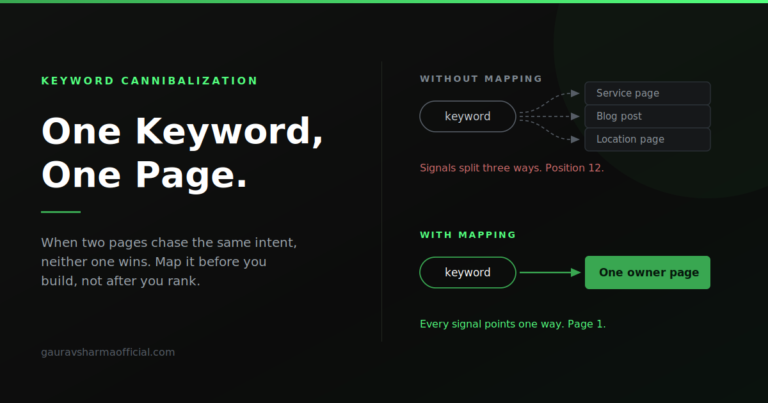
It’s when several of your pages target the same search and compete with each other. The fix is to map one keyword to one page, then merge, redirect or re-link the rest. Read how I map keywords.
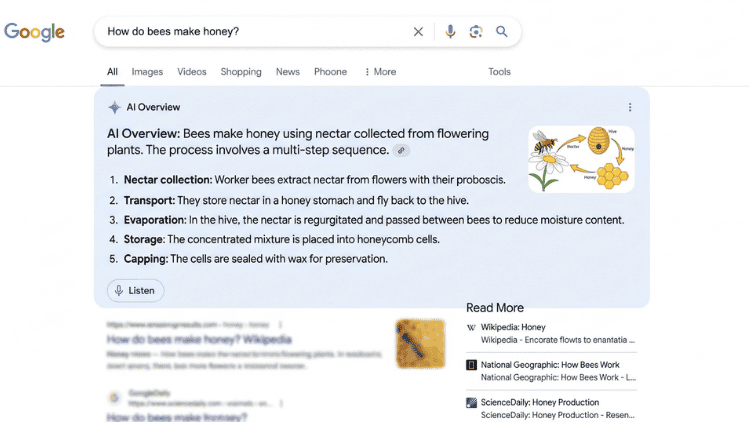
Yes. AI tools look for clear, well-organised passages from trusted sources that fully cover a topic, which is exactly what semantic content is. AI SEO & GEO service.
Working together
Refreshed pages can improve within weeks of being re-crawled. New content and topical authority usually build over three to six months, and keep compounding as the cluster grows.
Yes. I can provide the topical map and detailed briefs, then review and optimise what your team writes. Or I can handle the writing end to end.
Yes. I plan and write content for businesses in India and abroad, fully online, with updates and calls at times that suit you.
It depends on how many pages you need, how specialist the topic is and whether it’s new content or refreshes. Send your website on WhatsApp and I’ll share a clear scope and quote after a quick look.
Great content needs a healthy site and real authority behind it.

Crawling, indexing, speed and structure fixed at the root.
View service
Rank in the Google Map Pack and get more calls and visits.
View service
Get cited in ChatGPT, Gemini, Perplexity and Google AI Overviews.
View service
A complete check of what is holding your site back, with a fix list.
View service
Titles, headings, content and UX tuned for rankings and conversions.
View service
White-hat links and digital PR that build real authority.
View service
More patient calls for hospitals, clinics and healthcare brands.
View service
Steady high-intent property buyer leads without paid clicks.
View serviceSend me your website and your main competitor. I’ll show you the topics and questions they rank for that you don’t, and which of your pages to fix first.