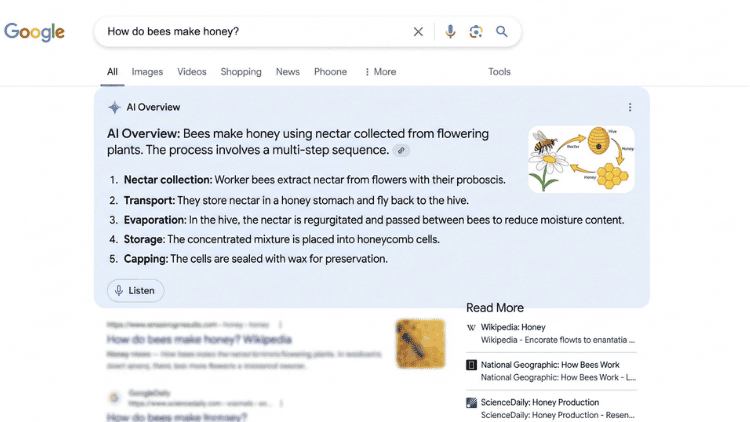

If you’ve searched anything on Google recently, you’ve already seen it. A clean AI-written answer sitting right at the top of the page, above every other result. No clicking. No scrolling. Just an answer.
That’s a Google AI Overview, and in 2026 it’s no longer experimental. It now appears in roughly 25 to 50% of informational searches, and it’s quietly rewriting the rules of SEO.
In this post, I’ll break down exactly how AI Overviews work behind the scenes, why some pages get cited while others get ignored, and what you need to do to actually show up inside them.
What Is a Google AI Overview?
A Google AI Overview is an AI-generated summary that appears at the very top of the search results page, before any organic listings or ads. It’s built using a customized Gemini AI model working alongside Google’s existing ranking systems and Knowledge Graph.
Instead of making you click through five different websites to piece together an answer, Google reads those websites for you and writes a direct, cited summary right there on the results page.
In simple terms, Google has become your research assistant.
How Does Google AI Overview Actually Work? (Step-by-Step)
Here’s the real mechanism behind it, broken into the exact steps Google follows:
1. Query Analysis
Google first analyzes your search query to understand the intent, the key topic, and how complex the question is. This determines whether an AI Overview should even appear for that search.
2. Query Fan-Out
This is the part most people don’t know about. Google doesn’t just search your exact query, it breaks one query into multiple related sub-queries and retrieves results for each of them simultaneously. This is called “query fan-out,” and it’s how AI Overviews end up pulling information from multiple angles of a topic.
3. Source Retrieval from the Existing Index
Here’s an important myth to clear up. There is no separate “AI crawler.” AI Overviews pull from the exact same web index that powers Google’s normal blue-link results. If your page isn’t ranking well organically, it’s very unlikely to be picked for an AI Overview either.
4. Passage Selection
Gemini scans the top-ranking pages and extracts specific passages, not entire pages, that directly answer the query. This is why writing in self-contained, extractable chunks matters so much (more on that below).
5. Synthesis & Citation
Gemini combines the selected passages from typically 6 to 14 sources into one coherent, readable answer. Citation chips and links are added next to the specific claims they support, so users can click through to the original source.
6. Display at “Position Zero”
The final summary is displayed above all organic results and ads. This is what the industry now calls Position Zero.
What Changed in the May 2026 Update?
Google rolled out a major structural update to AI Overviews on May 6, 2026, the biggest change since the feature launched. Here’s what’s new:
- Inline citations now sit directly next to the specific text they support, instead of being bunched at the end
- Hover previews show the site name and page title on desktop before you even click
- “Expert Advice” block, a new section that pulls first-hand perspectives from forums, social media, and review sites
- “Explore New Angles,” a section suggesting related subtopics at the end of the AI response
- “Subscribed” labels appear on links from paid publications
The big takeaway here is that Google is actively rewarding first-hand experience and expert perspective over generic, AI-written filler content. If you’ve actually done the work, run the audits, handled the clients, fixed the bugs, that experience now has a direct path into AI Overviews through the Expert Advice block.
Why Do Some Pages Get Cited and Others Don’t?
This is the question every business owner actually cares about. Based on analysis of tens of thousands of AI Overview results, here’s what consistently separates cited pages from ignored ones.
Pages That Already Rank Organically Get Priority
AI Overviews don’t invent new winners. They elevate passages from pages that have already earned visibility in normal search results. If you’re not ranking in the top 10 to 20 positions for a topic, your odds of being cited drop significantly.
This is exactly why the fundamentals haven’t changed. Crawlability, site speed, and clean indexing still matter just as much as they always did. I covered this in detail in my post on how SSR flaws can silently kill your crawl budget and stop new pages from ever getting indexed. If Google can’t properly render and crawl your site, none of this matters.
Content Has to Be “Extraction-Ready”
Gemini needs to lift a clean, self-contained answer, not piece one together from scattered context. A simple test: read each section of your page and ask, “Could an AI pull this out and have it make sense on its own?” If your paragraph says “as mentioned above” or “see the table below,” it fails this test.
The winning structure looks like this:
- Answer: a tight 40 to 80 word paragraph that directly resolves the question
- Proof: a stat, example, or first-hand data point that backs it up
- Action: a checklist, next step, or decision rule the reader can actually use
Schema Markup Still Matters, A Lot
Structured data helps Google understand exactly what your content is about, which makes it far easier for Gemini to extract and cite accurately. FAQPage schema in particular remains one of the strongest citation surfaces for AI Overviews, even though the visual FAQ rich result was removed from search earlier this year.
One important note from current data: schema validity beats schema volume. Three schema types implemented correctly with zero errors will outperform twelve types thrown on a page sloppily. Run your structured data through both Google’s Rich Results Test and the official Schema.org validator before publishing.
Long-Tail, Question-Based Queries Trigger AI Overviews Most
Searches phrased as questions (how, what, why) and searches with 7+ words are significantly more likely to trigger an AI Overview than short, generic keyword searches. This is a big shift from old-school keyword targeting toward writing content that mirrors how people actually talk and ask questions.
E-E-A-T Signals Are Enforced Harder Than Ever
For sensitive topics like health, legal, and finance, Google is far less likely to cite a page that doesn’t show clear Experience, Expertise, Authoritativeness, and Trustworthiness. Named authors, real credentials, and verifiable first-hand experience are now baseline requirements, not nice-to-haves.
Does an AI Overview Mean Your Traffic Is Doomed?
Not necessarily, and this is where most of the panic online gets it wrong.
Here’s the real pattern in the data: AI Overviews trigger on roughly 36% of informational searches, but only around 5 to 14% of commercial or transactional searches, the ones where people are actually close to buying or booking. Google deliberately backs off when someone is near a purchase decision, because those clicks still convert well in traditional results.
So the honest summary is this: informational top-of-funnel traffic has gotten thinner, while commercial and bottom-of-funnel traffic has largely held up. A business that understands this split can shift content investment toward searches that still convert, while competitors panic over the wrong number.
There’s also a silver lining for being cited. Pages that do get cited inside an AI Overview tend to see a meaningful traffic boost compared to a normal organic listing, because the citation acts as a built-in trust signal before the click even happens.
How to Actually Optimize for Google AI Overviews
Here’s a practical checklist you can start applying today.
- Lead with the answer. Open each page or section with a direct, 40 to 80 word answer to the core question. Don’t bury it under three paragraphs of intro.
- Structure content around real questions. Use H2s phrased the way people actually search, not generic marketing headers.
- Add proof, not fluff. Specific data, screenshots, and first-hand examples are far more likely to be lifted than vague claims.
- Implement clean, valid schema. Focus on FAQPage, Article, and Person schema, and validate everything.
- Build topical depth, not just single pages. Subtopic hubs supporting one central pillar page perform better than isolated posts.
- Add named authorship with real credentials. This directly supports the E-E-A-T signals Google is now weighing more heavily.
- Track AI citations separately from rankings. Use Search Console’s AI search appearance filter to see which pages are actually being pulled into AI Overviews. Rankings alone won’t tell you this anymore.
If you want a full technical audit of where your site currently stands against these factors, schema validity, crawlability, content structure, that’s exactly the kind of deep-dive I do as part of my Technical SEO and AI/GEO visibility services.
SEO vs. AEO: What’s the Difference?
You’ll see this term more and more in 2026, so it’s worth defining clearly.
- SEO (Search Engine Optimization): optimizing a page to rank in the traditional 10 blue links
- AEO (Answer Engine Optimization): optimizing a page to be selected, quoted, and cited inside an AI-generated answer
Both still matter. But AEO is where the new growth is happening, and most businesses haven’t adjusted their strategy for it yet. That’s exactly the opportunity.
Final Thoughts
Google AI Overviews aren’t a passing trend. They’re now a permanent, central part of how Google Search works, live in 200+ countries and 40+ languages. The mechanics are clear once you break them down: same index, same ranking fundamentals, but a new layer on top that rewards clean structure, real expertise, and content built to be extracted and cited.
The businesses that adapt early, with clean schema, extraction-ready content, and genuine first-hand authority, are going to be very hard to displace once everyone else catches up.
Want Your Site Optimized for AI Overviews?
If your organic traffic has felt unpredictable lately, or you simply don’t know whether your pages are AI-citation-ready, I can help you find out.