
If you’ve been relying on FAQ schema to grab extra real estate in Google search results, I have news for you — that strategy is officially over.
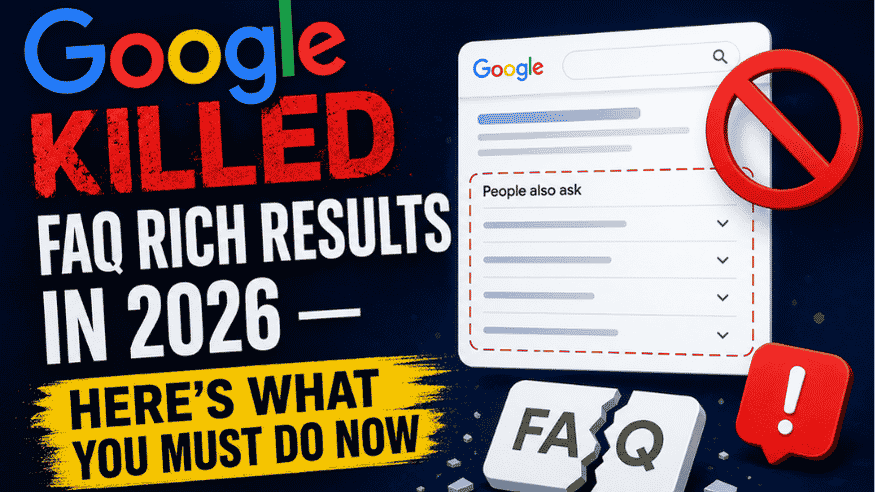
On May 7, 2026, Google permanently removed FAQ rich results from search. The expandable question-and-answer rows that used to stretch your listing down the page are gone. Not paused. Not reduced. Gone.
And yet, most businesses and SEO professionals haven’t changed a thing.
In this post I’ll break down exactly what happened, what it means for your rankings, and — most importantly — what you should be doing right now instead.
What Were FAQ Rich Results?
FAQ rich results were those expandable dropdowns that appeared directly under a website’s search listing. You’d see a result like:
Your Website — Best SEO Services ▼ What is SEO? ▼ How long does SEO take? ▼ How much does SEO cost?
They were achieved by adding FAQPage schema markup to your pages. For years, this was one of the easiest wins in technical SEO — add a few lines of structured data, get double the SERP space, push competitors down the page.
That era is over.
What Exactly Did Google Change?
Here is the confirmed timeline:
- May 7, 2026 — FAQ rich results stop appearing in Google Search across all site types, including government and health domains
- June 2026 — Search Console reporting for FAQ rich results is being removed, along with the Rich Results Test support
- August 2026 — API support for FAQ schema rich results ends completely
Google made no major announcement. No warning. No grace period. One day they were there, the next they weren’t.
Does This Mean You Should Delete FAQ Schema?
No. Absolutely not.
This is the part most people are getting wrong. The visual result is gone, but the schema itself still has significant value.
Google has confirmed that it still uses FAQPage schema to understand page content. In fact, pages with FAQPage markup are reportedly 3.2x more likely to appear in AI Overviews than pages without it.
Think about what that means. The shift isn’t from “schema matters” to “schema doesn’t matter.” It’s from “schema gets you a visual box in blue-link results” to “schema gets you cited inside AI-generated answers.”
That’s not a downgrade. That’s a different game — and a bigger one.
Why Did Google Remove FAQ Rich Results?
Google hasn’t given a detailed public explanation, but based on what we’ve seen in the industry, the reasons are fairly clear:
1. They were being abused. FAQ schema became one of the most spammed structured data types. Businesses were stuffing irrelevant Q&As just to steal SERP space, with no real value for users.
2. AI Overviews changed the equation. Google’s AI Overviews now answer many of the same questions that FAQ boxes used to display. Having both on the page created redundancy.
3. Click-through rates were already declining. With AI Overviews appearing above organic results, the visual benefit of FAQ rich results had already been shrinking throughout 2025.
This move is part of a bigger pattern — Google is slowly retiring SERP features built for the old web and replacing them with AI-driven answers.
What Should You Do Right Now?
1. Keep Your FAQPage Schema — But Make It Smarter
Don’t remove it. Reframe its purpose. Your FAQPage schema is no longer fighting for a visual box — it’s feeding AI systems.
Write your FAQ content as if you’re answering the exact questions an AI would need to summarise your page. Be specific. Use clear, direct language. Include your brand name and service area naturally.
If you need help auditing your existing schema setup, my Technical SEO services cover exactly this kind of structured data review.
2. Shift Focus to AI Overview Optimisation
The new prize is appearing inside Google’s AI Overviews — the AI-generated summaries that appear at the top of results. These pull from pages that are clearly structured, authoritative, and directly answer user questions.
To improve your chances:
- Write content in a clear Q&A or definition format
- Use headings that mirror how people ask questions
- Include specific data, examples, and original insights (AI systems prefer citable facts)
- Make sure your page clearly establishes E-E-A-T — who you are, your experience, and why you should be trusted
This is closely connected to what I wrote about in my post on crawl budget and indexing issues — if Google can’t efficiently crawl and render your pages, none of your schema work will matter anyway.
3. Monitor the New Search Console AI Performance Reports
Google is rolling out a dedicated AI performance section inside Search Console. This shows how your pages perform inside AI Overviews and AI Mode — completely separate from your traditional organic data.
This is a major shift in how we report and measure SEO results. Start paying attention to this report as it rolls out. It will tell you which pages are being cited in AI answers and which ones are being ignored.
4. Review Your Other Rich Results
FAQ rich results being removed is a signal — not an isolated event. Google dropped the Search Console features along with it. This is a good time to audit all your structured data:
- HowTo schema — Still active but being narrowed in scope
- Review schema — Still valuable, especially for local businesses
- Article schema — More important than ever for news and blog content
- Product schema — Critical if you run an ecommerce site
Not sure where your structured data stands? A full Technical SEO audit will surface every schema issue across your site.
5. Double Down on Content That AI Can’t Easily Summarise
Here’s a strategic opportunity most businesses are missing.
AI Overviews tend to absorb and answer generic, factual queries — “What is FAQ schema?”, “How does structured data work?” But they struggle with content that requires depth, nuance, first-hand experience, or proprietary data.
Write content that falls into that second category:
- Real case studies with your own data and screenshots
- Process walkthroughs based on things you’ve personally done
- Opinion-led analysis of industry changes (like this post)
- Local, niche, or industry-specific content that AI systems can’t easily generalise
This is also why I consistently recommend that businesses focus on building genuine topical authority rather than chasing individual keyword tricks. See how I approach this in my SEO Services and what a full organic growth strategy actually looks like.
The Bigger Picture: Search Is Changing Fast
The removal of FAQ rich results is just one update in a very active month for Google.
In May and June 2026 alone we also saw:
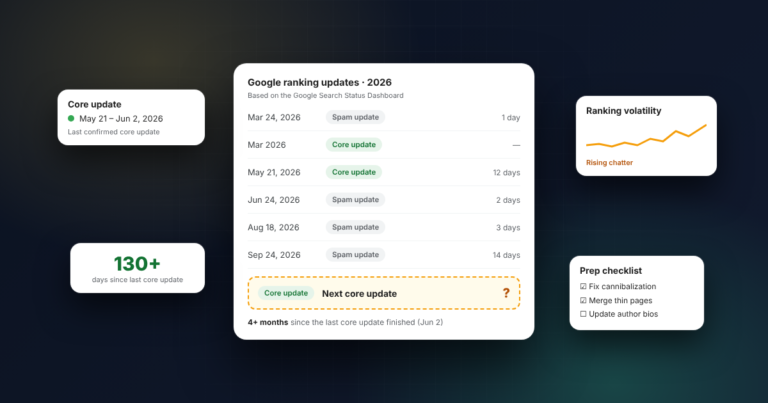
- A major May 2026 Core Update
- Google warning that buying or manipulating AI citations counts as spam
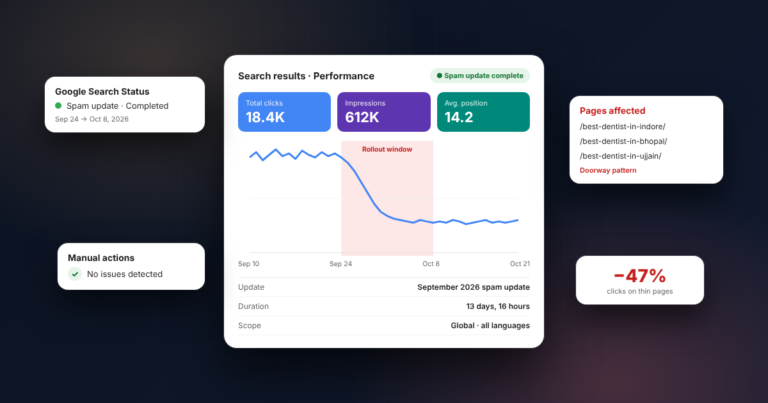
- An unconfirmed June 19 spam-targeting update that hit black-hat sites hard
- A 50-week data bug in Search Console that cannot be recovered
- Google quietly deindexing pages across many sites without explanation
The pattern is consistent. Google is cleaning up the old web, retiring tactics that gamed the system, and building a search experience driven by AI answers and genuine authority.
Sites that are clear, credible, well-structured, and written by real experts will continue to grow.
Sites that relied on schema tricks, thin content, or bought signals are going to have a difficult second half of 2026.
Summary: What to Do After FAQ Rich Results Are Gone
| What Changed | What To Do |
|---|---|
| FAQ rich results removed (May 7, 2026) | Keep FAQPage schema for AI Overview benefit |
| Search Console FAQ reporting ending | Switch focus to new AI Performance reports |
| AI Overviews now answer FAQ-style queries | Optimise content structure for AI citations |
| Schema abuse was being penalised | Audit all structured data across your site |
| Google deindexing thin/low-value pages | Prioritise content depth and E-E-A-T signals |
Need Help Adapting Your SEO Strategy?
These changes are happening fast, and most businesses are still running SEO strategies built for 2023.
If you want to audit your structured data, improve your AI Overview visibility, or build a technical SEO foundation that holds up through 2026 and beyond, I can help.
Gaurav Sharma is a freelance SEO expert with 7+ years of experience helping businesses improve Google rankings, AI search visibility, and organic traffic. Based in India, working with clients globally.